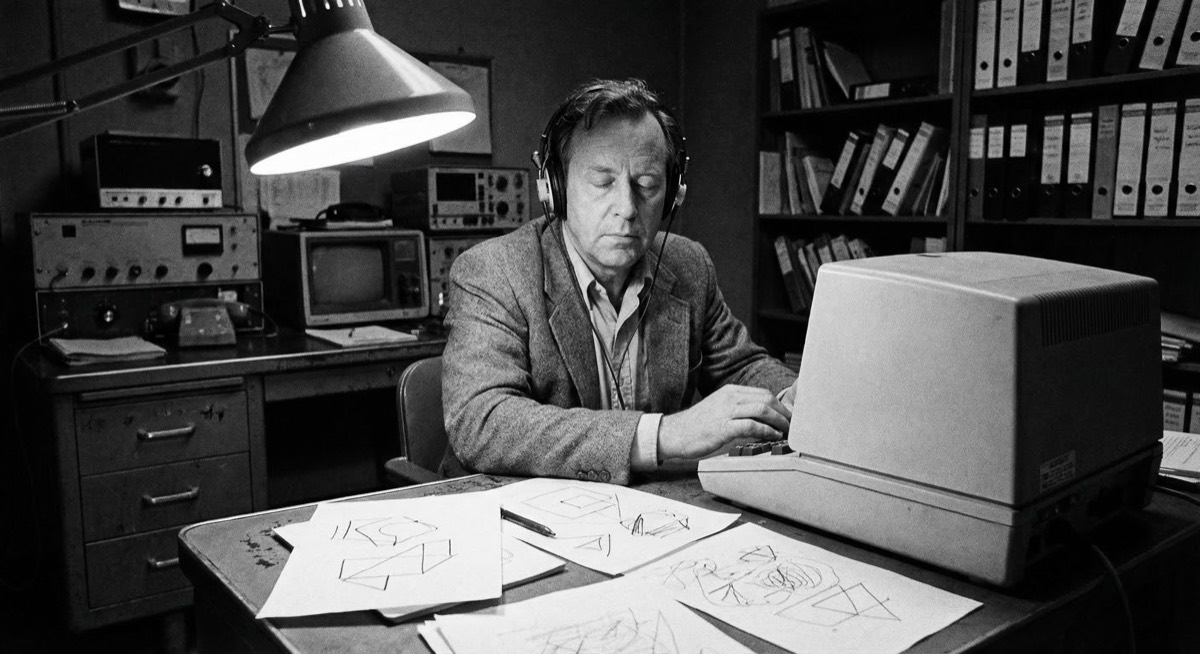
In 1995, the CIA released a trove of documents that would have seemed like science fiction a decade earlier: for more than two decades, the U.S. government had been funding, training, and deploying human beings who could — under controlled laboratory conditions — perceive locations, objects, and events at any distance, using nothing but their minds.
The program was called Project STARGATE. It ran from 1972 to 1995, cost an estimated $20 million in taxpayer funds, and produced results that remain scientifically contested — but statistically undeniable.
Origins: The Intelligence Gap That Started Everything
Project STARGATE did not begin as a single program. It evolved from a cluster of earlier initiatives — SCANATE, GONDOLA WISH, GRILL FLAME, CENTER LANE, SUN STREAK — all sharing a common premise: the Soviet Union was investing heavily in "psychotronics," and the United States could not afford to fall behind.
In 1972, physicists Hal Puthoff and Russell Targ at Stanford Research Institute (SRI) in Menlo Park, California, began studying a New York artist named Ingo Swann. Swann had claimed since childhood to experience anomalous perceptions — knowledge of distant places, events, and objects that he had no conventional way of accessing. What he brought to SRI wasn't mysticism. It was rigor.
Swann proposed a structured protocol: instead of relying on spontaneous impressions, a viewer would be given a pair of geographic coordinates — latitude and longitude — with no other information. The viewer would then describe what existed at those coordinates. No feedback before the session. No prior knowledge. Just numbers.
The CIA funded initial research, and early sessions — including Pat Price's legendary 1974 session targeting a Soviet facility — were enough to keep the money flowing for another twenty-three years.
The SRI Years: Building the Science
Between 1972 and 1985, Puthoff and Targ conducted hundreds of controlled remote viewing experiments at SRI. Their methodology was designed specifically to counter skeptical objections: viewers were blind to target information, judges who evaluated transcripts were blind to which viewer produced which session, and statistical analysis was conducted by third parties.
Key SRI Protocol Controls
- Blind targets: Viewer received only coordinates or a random reference number
- Blind judges: Evaluators matched session transcripts to target photos without knowing which viewer did which session
- Pool selection: Targets chosen randomly from large pools to prevent cueing
- Electroencephalographic monitoring: Some sessions conducted with EEG to track neural correlates
Their results were published in peer-reviewed journals, most notably in Nature (1974) and Proceedings of the IEEE (1976). These weren't fringe publications. Nature's editorial board debated publishing the paper for months — and ultimately did so, with the note that the experiments deserved scientific attention regardless of one's prior beliefs.
Ingo Swann and the Development of CRV
Ingo Swann (1933–2013) was the intellectual architect of what became Controlled Remote Viewing (CRV). Recognizing that raw psychic talent was inconsistent and difficult to train, Swann developed a structured, stage-based approach that broke a session into discrete phases — each phase designed to extract specific categories of information while preventing the viewer's analytical mind from interfering.
Swann's key insight was that the analytical overlay — the trained human tendency to interpret and contextualize sensory data — was the primary enemy of accurate remote perception. CRV's stage structure was engineered to keep the viewer's ideation in "signal line" rather than "noise" for as long as possible, extracting raw perceptual data before the analytical mind could contaminate it.
By the early 1980s, Swann had developed a full six-stage CRV protocol, which he began teaching to military remote viewers at a program then called GRILL FLAME, operating out of Fort Meade, Maryland.
Train the Protocol
The same CRV protocol developed at SRI is now available as an AI-scored training system. Psionic Training tracks your accuracy across five dimensions — the same ones the STARGATE researchers measured.
Start Training →Operational Use: What Remote Viewers Actually Did
While the scientific research continued at SRI, a parallel operational program was running at the Defense Intelligence Agency (DIA). Remote viewers — some military, some civilian — were tasked with real intelligence targets.
Documented operational applications include:
- Soviet submarine tracking: Remote viewer Joseph McMoneagle reportedly provided accurate descriptions of a new class of Soviet ballistic missile submarine under construction at a hidden facility — months before satellite imagery confirmed it.
- Hostage location: During the Iran hostage crisis, remote viewers were tasked with locating the 52 American hostages being held in Iran.
- Chinese nuclear facility: Viewers provided descriptions of a Chinese nuclear test facility later corroborated by overhead imagery.
- Downed aircraft: In 1977, a remote viewer identified the approximate crash location of a Soviet Tu-22 aircraft in Africa.
- Narcotics interdiction: In the program's later years, STARGATE assets were tasked by the DEA on drug trafficking operations.
"The program produced some startling successes. There were sessions where the information was so accurate and so detailed that it was simply not possible to attribute it to chance or to any conventional intelligence source."
— David Goslin, reviewing the STARGATE program for the American Institutes for Research (AIR), 1995
The 1995 Declassification
In 1995, Congress tasked the CIA to commission an independent review of the STARGATE program. The American Institutes for Research (AIR) was contracted to evaluate both the scientific evidence and the operational utility of remote viewing.
The AIR review, led by statistician Jessica Utts and skeptic Ray Hyman, reached notably split conclusions. Utts concluded that the anomalous effect was real and replicable: effect sizes were consistent across laboratories, and the probability that the results were due to chance was vanishingly small. Hyman, while acknowledging that the statistical evidence was compelling, argued that methodological flaws hadn't been fully eliminated.
The CIA chose to terminate the operational program, citing insufficient evidence of practical intelligence value — though the scientific question was explicitly left open. Following declassification, the CIA released approximately 89,000 pages of STARGATE documents into the CREST database, where they remain publicly accessible today.
The Scientific Evidence: What the Data Actually Shows
Subsequent meta-analyses of the SRI and SAIC remote viewing databases have consistently found statistically significant effects that cannot be explained by chance, selective reporting, or conventional sensory leakage.
Legacy: What STARGATE Changed
Project STARGATE permanently altered the landscape of consciousness research. It produced a substantial body of peer-reviewed literature, trained dozens of operational remote viewers who went on to teach the CRV protocol to thousands of civilians, and established the first rigorous scientific framework for studying what researchers now call "anomalous cognition."
Perhaps most importantly, STARGATE demonstrated that psychic functioning, whatever its ultimate mechanism, is a trainable skill — not an innate talent available only to a few. Viewers who began with no particular history of anomalous experience became operational assets through structured practice.

Ready to experience the protocol yourself? Psionic Training is the only AI-scored CRV training app built on the declassified STARGATE methodology.
Begin Training →Further Reading
- Targ, R. & Puthoff, H. (1974). "Information transmission under conditions of sensory shielding." Nature, 251, 602–607.
- Utts, J. (1995). "An Assessment of the Evidence for Psychic Functioning." Journal of Scientific Exploration, 10(1).
- May, E.C., et al. (1995). "SAIC Remote Viewing Program: An Evaluation of the Evidence." Journal of Parapsychology.
- CIA CREST Database: Project STARGATE documents, NARA/CIA, declassified 1995–2017.
- Swann, I. (1993). Natural ESP: A Layman's Guide to Unlocking the Extra Sensory Power of Your Mind.
Intel Briefings
Stay in the signal: analysis of declassified research, remote viewing science, and new findings. No noise.